In our commitment to making our books accessible to all readers, MQUP now asks authors to provide alt text for images in addition to captions.
As the author, you are the expert on the images in your manuscript and are in the best position to create the alt text. You know why you have selected each image for inclusion in the book and what information it conveys that the text cannot on its own. By using alt text, you can ensure that all readers, including those with print disabilities and those who use assistive technologies such as screen readers, have access to the entirety of your meaning and argument.
Please submit alt text in a separate Word document as a list, just as you would do for a list of captions.
What Is Alt Text?
Alternative text (alt text) is a short written description of a visual element for readers who use a screen reader or other assistive device. It conveys important information that isn’t available anywhere else on the page (i.e., in the caption or in the main text).
Guidelines for Writing Alt Text
- Don’t repeat the image’s title or caption (alt text is supplementary to a caption). Avoid duplicating anything in the surrounding text.
- Keep it short – ideally, 50 words (200 characters) or less. Alt text is read linearly by screen readers, so users have to listen to the entire text before they can continue reading.
- Tone and language: Use active verbs in the present tense and descriptive vocabulary, and write out abbreviations and symbols to ensure proper pronunciation by screen readers.
- Decorative images that don’t convey any meaning to the reader (e.g., chapter-opening graphic elements) do not need alt text.
- Context: Think about why the image is there for visual readers. Descriptions for the same image may differ depending on the context. For example:
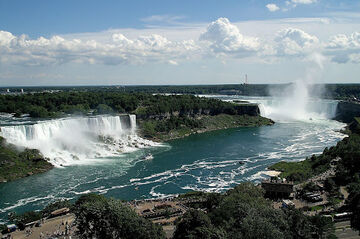
Alt text for a travel guidebook:
A photograph of the American, Bridal Veil, and Horseshoe Falls, seen from a high vantage point and brightly lit on a sunny day.
Alt text for an ecological text:
A photograph of Niagara Falls, with atomized water rising prominently from the falls that creates a surrounding spray zone.
Source: 3 Fall Niagara, by Saffron Blaze, courtesy of Wikimedia Commons.
Extended Descriptions
If an image requires more than 200 characters of explanation, please prepare both alt text and an extended description. An extended description is text that is hidden from a sighted user (unless they click on “description”), but that will be read by a screen reader. Much more detail can be provided in an extended description without inhibiting the flow of the main text.
Types of Images That May Require an Extended Description
- An image of a document;
- Charts and diagrams; and
- Images where you expect the reader to notice specific details.
Examples of Images Requiring Alt Text
Informational images (art, illustrations, etc.)
- Alt text should include a brief description, including relevant details or context for why the image is included.
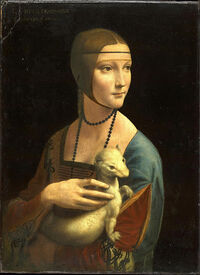
Caption: Lady with an Ermine (Dama con l’ermelli), Leonardo da Vinci, circa 1490. Commissioned by Ludovico Sforza, the portrait depicts his mistress Cecilia Gallerani.
Alt text: An oil and tempera painting of a young woman, richly dressed, holding a large white ermine in her arms against a black background.
Source: The Lady with an Ermine (Portrait of Cecilia Gallerani), by Leonardo da Vinci (1452–1519), courtesy of Wikimedia Commons.
Complex figures (graphs and diagrams)
- Alt text should include the type of chart or graph, the data it provides, and the reason for its inclusion.
- If possible, it is encouraged that you submit a graph or chart’s original data as a table. This can be included in the extended description and ensures that all readers understand the full scope of what you are communicating.
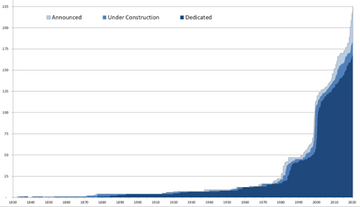
Caption: Number of temples of the Church of Jesus Christ of the Latter-Day Saints, 1830–2020.
Alt text: A trend chart that identifies the cumulative number of temples announced, under construction, and dedicated. The total number stays consistent from 1830 to 1980, at which point there is a sharp increase in 1980 and again in 2000.
Extended description: [Ideally, the graph’s data is included here as a table. If this is not possible, please provide as much information as possible. E.g., “The total number of temples announced, built, and dedicated stays under 25 from 1830 to 1980, at which point there are a number of sharp increases: the total is nearly 50 by 1990, 125 by 2000, nearly 175 by 2010, and 225 by 2020.”]
Source: Temple Graph December 2020, by Glennfcowan, courtesy of Wikimedia Commons.
Maps
- Alt text should include the scope of the map, a brief description of its intent (political, geological, etc.), the date, and notable features.
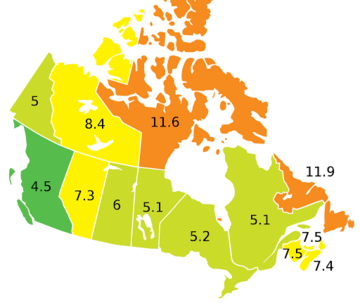
Caption: Unemployment rates by province, January 2020.
Alt text: A map of Canada that shows that British Columbia has the lowest unemployment rate (4.5 per cent) and that the Northwest Territories and Newfoundland and Labrador have the highest (11.6 and 11.9 per cent, respectively).
Possibility of an extended description if further information is salient to the book.
Source: Unemployment Rate Map of Canada (January 2020), by Judicieux, courtesy of Wikimedia Commons.
Reproductions of texts or documents
- Notable features can be placed in the alt text.
- Any legible document contents should be reproduced in the extended description. For documents containing languages other than English, contact the Managing Editor.
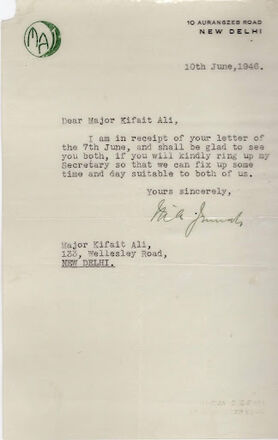
Caption: A 1946 letter from Muhammad Ali Jinnah to Major Kifait Ali.
Alt text: A letter with small tears that is written by typewriter, except for the ink stamp of the initials “MAJ” at the top of the page, and Jinnah’s signature below.
Extended description: [A full reproduction of the letter’s contents, including header, date, and address.]
Source: Quaid’s Letter to Kifait, by Zubairmianali, courtesy of Wikimedia Commons.
Further Resources
DIAGRAM Center, “Image Description Guidelines”
A detailed guide to best practices for image descriptions (including alt text), with examples. http://diagramcenter.org/table-of-contents-2.html.
DAISY Consortium, “Image Descriptions”
A technical guide to adding alt text and extended descriptions to ebook or website markup (for those who are curious), along with a more descriptive overview of the writing process (relevant to all). https://kb.daisy.org/publishing/docs/html/images-desc.html#writing.
Humber Polytechnic, “Making Accessible Books”
A Canadian educational resource on accessible publications, including helpful examples.
https://humber.ca/makingaccessiblemedia/makingaccessiblebooks/.
Please let us know if you have any questions!